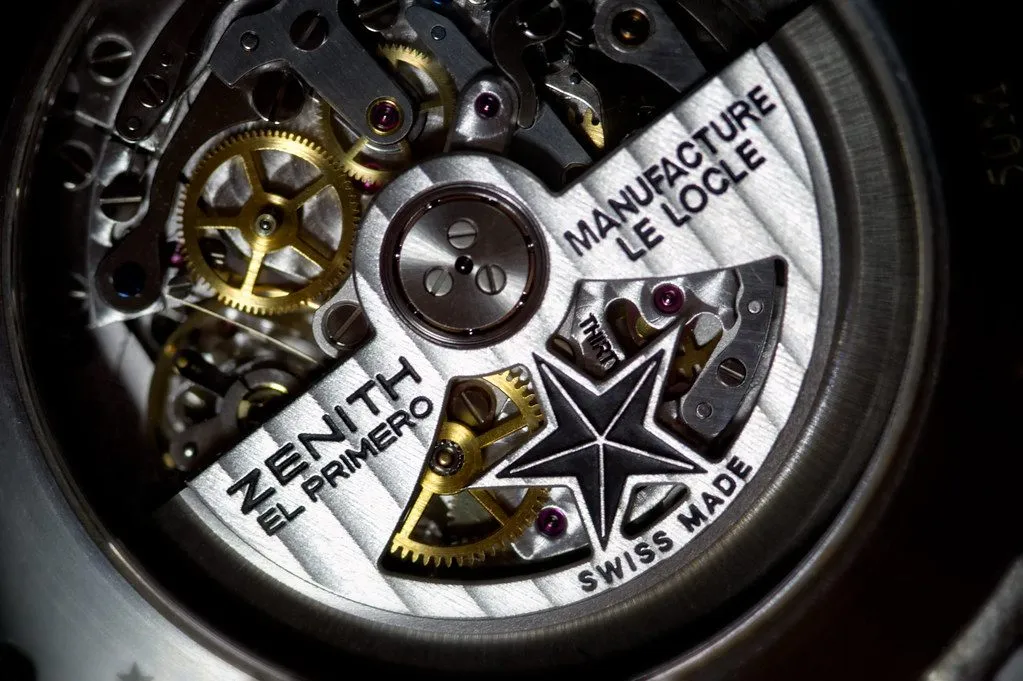
The heart of a mechanical watch is the balance wheel, a wheel with a very fine hairspring that swings back and forth at a steady rhythm. Each swing is a beat, or vibration, and the rate is given in beats per hour (bph). It is also given in hertz: one hertz is two beats per second.
The usual figures
- 21,600 bph (3 Hz). Six steps of the seconds hand per second. The rate of nearly every automatic in this catalogue.
- 28,800 bph (4 Hz). Eight steps per second: the seconds hand looks smoother. The rate of many classic Swiss movements, such as the Sellita SW200-1 in the Glycine Airman, and of the Citizen 0950.
- 36,000 bph (5 Hz). High beat, reserved for special movements such as the Zenith El Primero in the photo.
What you gain and what you lose
A balance that swings faster is less affected by knocks and by the position of your wrist, so it tends to be more stable. In return, it uses more energy and wears the oils sooner. That is why the Swatch Group went the other way with the Powermatic 80: it dropped from 28,800 to 21,600 bph to stretch the reserve to 80 hours.
The catalogue by beat rate
| Beat rate | Watches | Examples |
|---|---|---|
| 21,600 bph | 17 | Invicta Pro Diver, Citizen Automatic NJ0190, Citizen Promaster Fugu, Citizen Tsuyosa… |
| 28,800 bph | 3 | Citizen Promaster Fujitsubo, Citizen Series 8 870 Mechanical, Citizen Series 8 880 GMT |