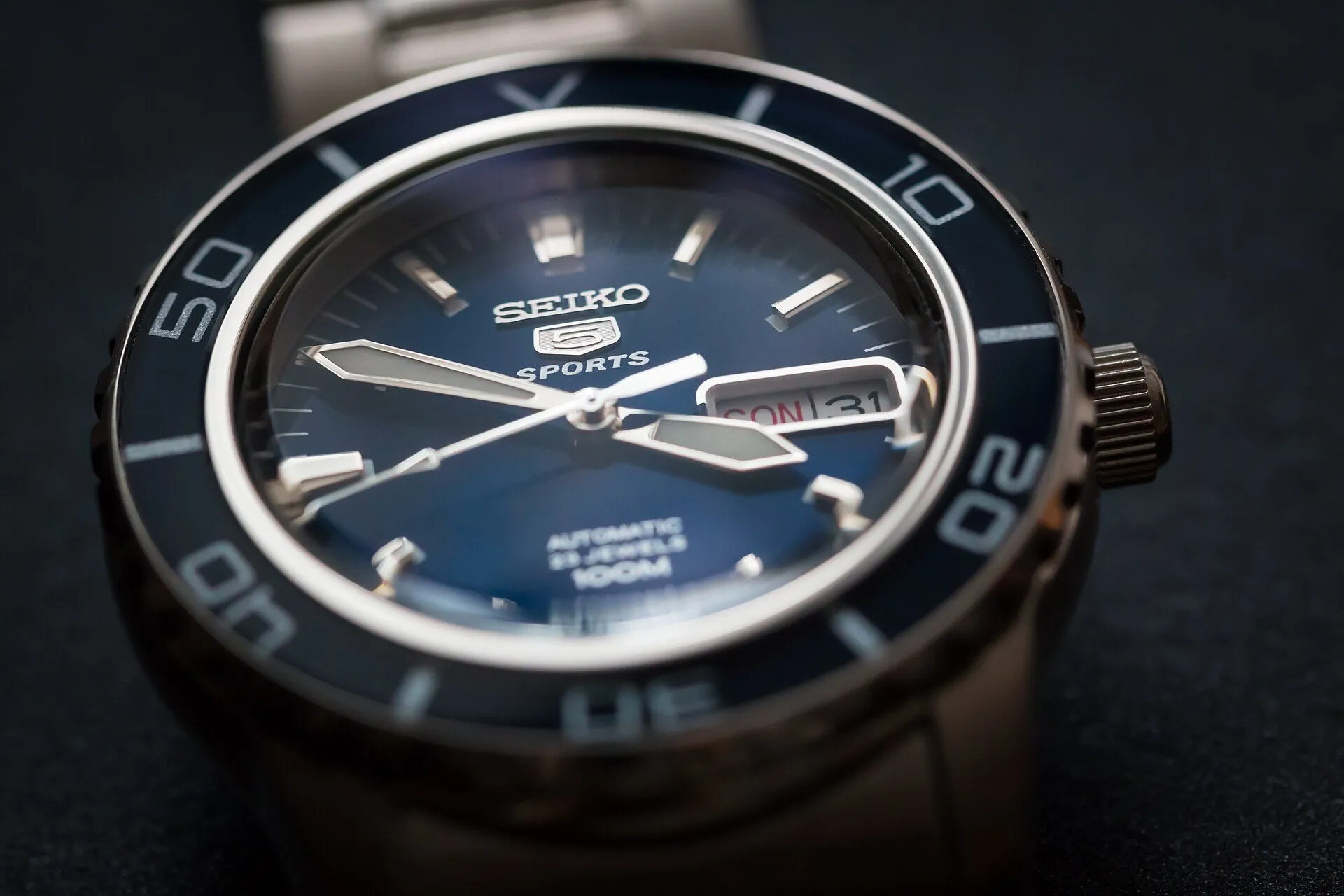
A GMT watch has a fourth hand that goes round the dial once every 24 hours, instead of twice like the hour hand. You read it against a 24-hour scale on the dial or bezel, and it tracks a second time zone: home when you travel, or someone who lives far away.
The name comes from Greenwich Mean Time, the time at the Greenwich meridian. Pilots made it popular in the 1950s to read local and reference time at once.
How to read it
Set the 24-hour hand to the time in the other zone. Because it goes round once a day, it also tells you whether it is day or night there. If the bezel turns and has a 24-hour scale, you can read a third zone: turn it by the number of hours’ difference.
Travel GMT and office GMT
- Travel (flyer): the hour hand jumps hour by hour without stopping the watch. When you land you change local time in a moment, and the 24-hour hand keeps showing home time.
- Office (caller): the 24-hour hand is the one set independently. To change local time you move all the hands. It is simpler to make and is the norm under €1,500; the Seiko 4R34 works this way.
Both read two time zones equally well. The difference is how convenient it is to change the time when you travel.
The automatic GMT watches in the catalogue
| Watch | Movement | Diameter | Crystal | Reserve | Price band |
|---|---|---|---|---|---|
| Seiko 5 Sports GMT | 4R34 | 42.5 mm | Hardlex | 41 h | €420–470 |
| Seiko Presage Style 60's GMT | 4R34 | 40.8 mm | Hardlex | 41 h | €600–660 |
| Citizen Series 8 880 GMT | 9054 | 41 mm | Sapphire | 50 h | €1,200–1,290 |
You can compare them on every figure in the GMT watches list. How to set them without harming the date is in the guide to setting an automatic.