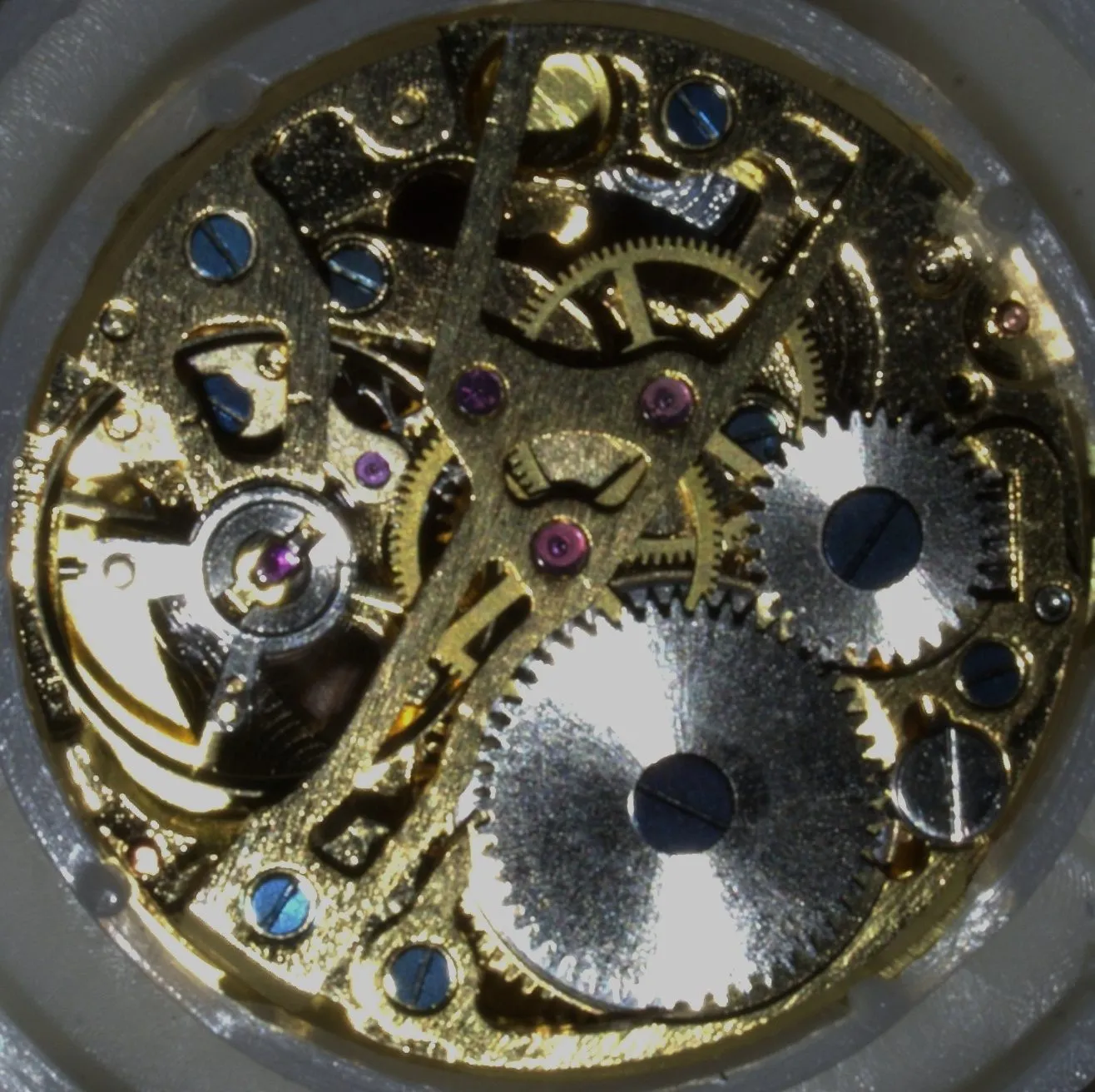
An automatic watch is a mechanical watch that winds itself. There is no battery or circuit inside: all the energy comes from your wrist and is stored in a spring. Knowing how one turns into the other makes the spec sheets easier to read, because almost every figure we compare comes from one of these parts.
From rotor to mainspring
On the back of the movement sits a rotor, a half-moon of metal that spins freely whenever you move your arm. A train of gears turns that motion into winding for the mainspring, a coiled steel strip inside a drum called the barrel. With the spring wound, the watch keeps running after you take it off: that autonomy is the power reserve.
Many movements can also be wound by turning the crown. That is hand winding, useful for starting a watch that has stopped.
Escapement and balance wheel
If the spring let go all at once, the watch would run down in seconds. The escapement prevents that by releasing the energy in small, regular pulses. The pace is set by the balance wheel, a wheel with a very fine hairspring that swings back and forth. Each half-swing is a beat: at 21,600 beats per hour the seconds hand moves in six steps a second, at 28,800 in eight. That is the frequency on the spec sheets.
Jewels are synthetic rubies the wheel pivots turn in, to reduce friction. A typical automatic has 21 to 26.
Automatic, hand-wound and quartz
- Automatic: mechanical and self-winding. It stops if you leave it off for longer than its reserve, and gains or loses a few seconds a day.
- Hand-wound: the same mechanism without a rotor. You wind it with the crown every day or two.
- Quartz: a battery makes a quartz crystal vibrate 32,768 times a second and a circuit counts the vibrations. It is more accurate, cheaper and thinner, but relies on the battery.
Why choose an automatic? It needs no battery, a good movement lasts decades with servicing, and the seconds hand sweeps instead of ticking. Why not? If all you want is the exact time and to forget about the watch, quartz does it better for less.
What the spec sheets tell you about each part
Every watch page shows the movement and its maker, the power reserve, the frequency, and whether it has hacking seconds and hand winding. To see which mechanism each watch uses, start with the movements page; if you are choosing your first one, with the buying guide.